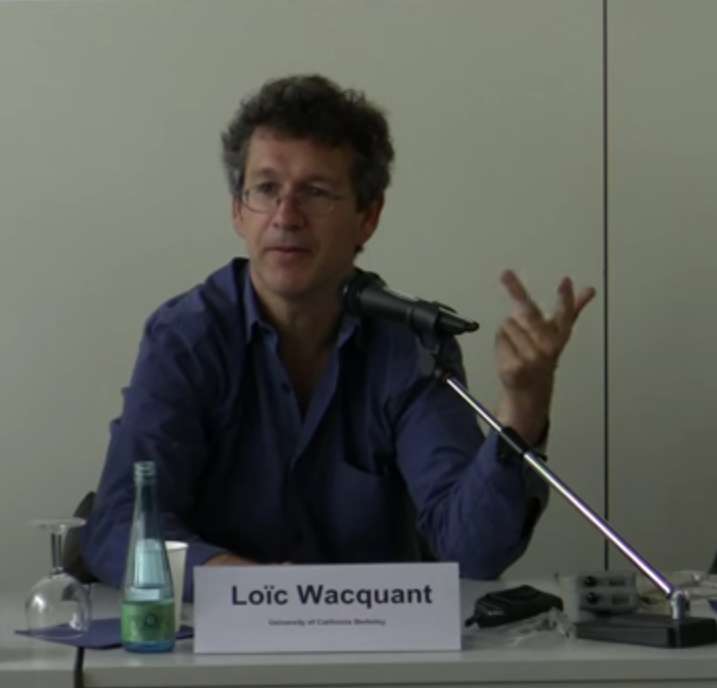
Loïc Wacquant combines an analysis of bodily learned dispositions with studies of neighborhoods, poverty, and criminal justice policy. Through the boxing gym, he demonstrates how the body learns a social world. Through comparisons of marginalized areas, he shows how place, the state, and stigma are intertwined. His sociology helps us see both local agency and the institutions that create vulnerability.

Embodied Knowledge and Participatory Sociology
In *Body and Soul*, Wacquant learned to box in order to investigate how a practice becomes physically comprehensible. Technique, rhythm, pain, gaze, and discipline are not learned solely through words. The body is shaped in an environment of equipment, coaches, peers, and repeated practice.
He sometimes calls this a bodily or carnal sociology. The researcher uses their own body as an instrument of knowledge, but the experience must still be analyzed and compared. For *The Good Life*, this perspective shows how environments can build capacity through gradual participation.
Create a bodily learning map
Purpose: To illustrate how a social practice is learned through the body, tools, and feedback.
Choose a safe skill that you already practice or can begin to practice under supervision.
Note the movement, rhythm, attention, and equipment required.
Describe how other participants demonstrate what constitutes a good performance.
Identify a specific step that needs to be practiced more slowly or more clearly.
Try the specific element and document what your body now perceives that it previously missed.
Afterward: Knowledge isn’t just found in an explanation. It is built through a socially organized practice process.
Limitations and when the exercise should not be performed: Do not practice contact sports, dangerous techniques, or medical procedures without qualified supervision.
Advanced Marginality
Wacquant uses the term “advanced marginality” to describe forms of vulnerability concentrated in certain urban areas, while ties to stable employment and public institutions weaken. This should not be confused with a single, universal underclass. History, the state, and the housing market give rise to different forms in different countries.
Vulnerability consists of more than just low income. It encompasses insecurity, institutional withdrawal, a stigmatized address, and weak collective representation. Measures that focus solely on training the individual therefore overlook the relationships between work, housing, and the state that reproduce this position.
Create an institutional map of the conditions in a given area
Purpose: To distinguish local resources from the decisions and institutions that shape marginalization.
Choose an area about which you have legitimate knowledge and use public statistics and local sources.
Map out employment, public transportation, schools, healthcare, community organizations, and homeownership.
Note which institutions have withdrawn or become more controlling.
Include local networks and resources that a “deprivation map” would overlook.
Formulate a change at the level that actually controls a key condition.
Afterward: The map should show both capacity and institutional barriers without attributing the location as a characteristic of its residents.
Limitations and when the exercise should not be conducted: Do not publish sensitive locations or information, and do not enter an area as an observer without a connection or invitation.
Territorial Stigma
Territorial stigma means that an address or neighborhood is associated with perceptions of danger, failure, and inferiority. Residents may face suspicion in the workplace and in dealings with government agencies and may themselves need to distance themselves from their neighbors or the location in order to be accepted.
Stigma can influence investment and policy and thereby contribute to the very problems that are used as evidence of its existence. Resistance must therefore both change material conditions and create ways for residents to represent the complexity of the place without being forced to promote it in a positive light.
Trace a territorial stigma from word to consequence
Purpose: To demonstrate how a category of place influences treatment, resources, and residents’ strategies.
Choose a place that is repeatedly described using simplified public language.
Gather some public statements from media or documents.
Track which decisions regarding services, oversight, or investment are linked to that image.
Seek out local voices and information that reveal diversity without romanticizing the situation.
Formulate a more precise description and a concrete action that should follow from it.
Afterward: A counter-narrative is not enough if resources and institutions continue to perpetuate the stigma.
Limitations and when this exercise should not be done: Protect residents’ privacy and avoid reposting offensive images or labels unnecessarily.
The Punitive State, the Welfare State, and Shared Public Power
In *Punishing the Poor*, Wacquant analyzes how social support and punitive control can develop in tandem. The state can withdraw social security while simultaneously increasing surveillance, conditions, and sanctions targeting marginalized groups. He describes this as an asymmetrical or centaur-like state.
For the good life, the question is how public power addresses needs and rule-breaking. Support without rights can become arbitrary, while control without resources can deepen marginalization. Institutions need to combine clear boundaries with material pathways back into society.
Compare support and control in a public process
Purpose: To determine whether an institution provides people with real resources to meet the requirements it sets.
Choose a public process that you can examine through regulations and publicly available materials.
List the requirements, controls, and possible sanctions.
List the support, time, information, and appeal avenues that are offered.
Assess where a requirement lacks a corresponding resource or a reasonable avenue for reinstatement.
Propose a change that strengthens both legal certainty and the actual possibility of success.
Afterward: A fair process enables accountability through clear rules, resources, and due process.
Limitations and when not to use this exercise: Legal matters require expert advice. Do not use this exercise as a substitute for an appeal or legal representation.